Overview

Watch “What is ARB?”-






The Problem
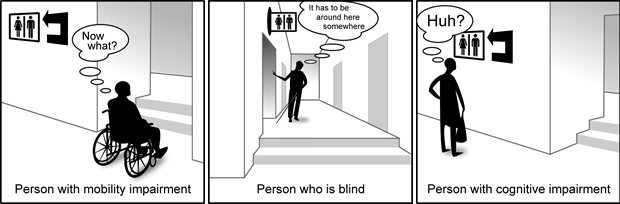
People with disabilities face accessibility challenges due to various physical, sensory, and cognitive obstacles both while entering and maneuvering within community buildings. People with disabilities may not know about these barriers until they encounter them, which ultimately affects their level of participation in the community. These apps allow people to determine which establishments will best serve their needs, plan alternatives, bring assistance, or avoid particular barriers. ARB is a collection of simple, portable evaluation and reporting tools that will enable building assessors to broadcast details about any building’s accessibility.
The Goal: Accessibility Information About Public Buildings
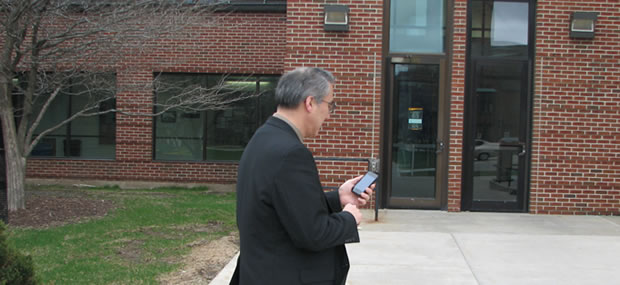
ARB users first create a profile, allowing the system to personalize the display of building information that is most related to the individual’s specific accessibility needs. Users may choose to view summary reports or navigate through the details, with information provided from other people with disabilities and building visitors who have shared personal accessibility testimonials and ratings for particular buildings.
Building data is populated by building visitors with accessibility needs as well as trained accessibility evaluators. Users share comments and rate as many (or as few) of the building’s accessibility features (or lack thereof) as they like. Trained building evaluators perform a comprehensive assessment of the building’s publicly visited areas, collecting a significant number of objective measurements.
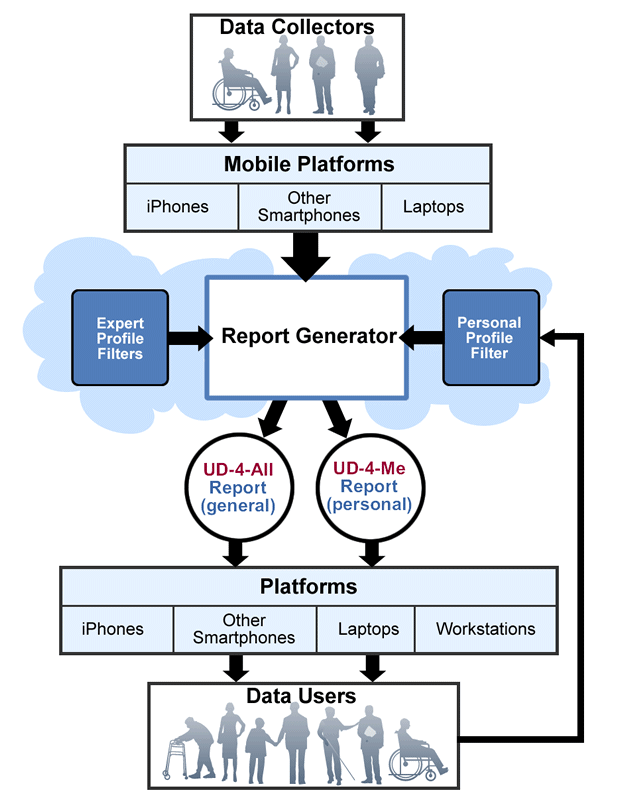
In the above figure, Data Collectors use mobile platforms to input building accessibility data into the Report Generator cloud. As not all users have mobile devices, we have expanded our plan to include data collection via desktop computers. Personal Profiles created by users are used to filter building accessibility data and generated personalized UD-4-Me reports for each user. Expert-created profiles for common impairments are used to filter the building accessibility for general UD-4-All reports, which summarize the building’s accessibility for a range of impairments. The reports are made available to Data Users through multiple platforms, including smartphones, tablets, laptops and desktop workstations. This figure does not clearly illustrate the significant overlap we expect between Data Collectors and Data Users.
Current Work
The ARB team has developed a preliminary taxonomy specific to restaurants that is being expanded to address public buildings in general. This taxonomy includes user demographics, building types, general building elements, detailed ADAAG requirements and additional functional building elements related to accessibility, a subjective experience rating domain, and individual subjective building element prioritization. These data are organized and structurally integrated to create both data collection and reporting interfaces for three major user groups:
- building users (targeting people with disabilities, friends or relatives)
- building evaluators (including advocates and building assessors)
- building overseers (such as owners, managers, and policy makers)
In order to meet the identified needs, we have created a set of apps that provide community accessibility ratings, similar to movie ratings (e.g., 4/5 stars). These apps include AccessPlace and AccessTools, both of which focus on providing an overall rating of every aspect of a building. AccessPlace is designed with high usability for any individual wanting to leave a rating on a building. AccessTools is designed to allow a more in–depth rating specifically for the owners of the building or an individual who specializes in proper building accessibility rating. In addition, there are three active Mini-Tools including Access-Slope, AccessRuler, Access-Sound, and soon–to–be AccessLight. Each of these tools specializes in a specific aspect of accessibility (e.g. sound in a room or the slope of a ramp). These Mini-Tools are used both on their own as well as within the AccessTools app providing concrete measurements and accurate data collection.
Mobile and Web-based System Development
AccessRatings for Buildings (ARB) aims to develop a mobile and web-based system that will provide up-to-date accessibility information about public buildings for people with disabilities, their families and friends, and building owners. This system is divided into five components: AccessPlace Mobile and Web, AccessTools, and three mini-Tools: Access Slope, AccessRuler, Access-Sound.
Access Place
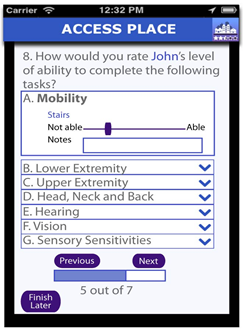
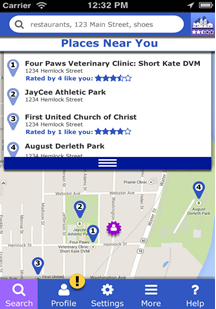
Access Place is a multi-platform mobile and web application designed for end-users to communicate and obtain Personalized Accessibility Information (PAI) tailored to the individual’s functional impairments. The user creates a profile (Functional Impairment Profile, shown above) that allows the system to personalize the display of building information that is most relevant to their specific accessibility needs. The user may also view information provided by other people with disabilities and building visitors concerning the accessibility of various businesses. Reviews written by users with comparable profiles are sorted toward the top of the search list, and their ratings are given greater weight in correspondence to their level of similarity. This allows users to better prepare for environmental challenges they may face in a particular setting.
Watch “Access Place”-
Access Tools
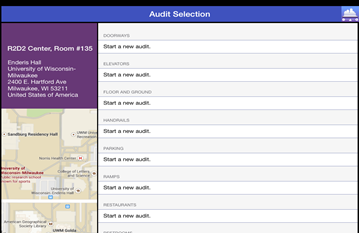
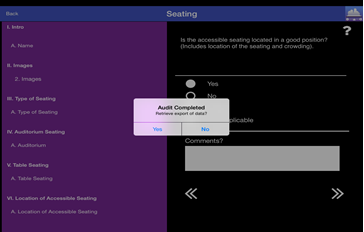
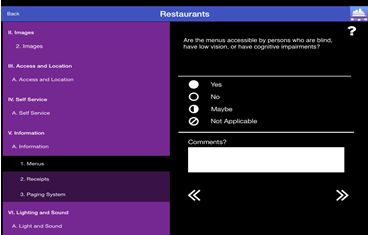
Access Tools (Figs. 13-16) incorporates twelve AUDITs into one mobile application so the accessibility features of entire buildings can be assessed. The features of buildings that can be evaluated are doorways, elevators, floor and ground, handrails, parking, ramps, restaurants, restrooms, routes, seating, signage, and stairs (Fig. 13). Users record details concerning each of these areas while out, or afterwards. Answers are presented in a trichotomous manner: yes, no, maybe, and not applicable (Fig. 14). The answer chosen for one question determines which question is presented next. For instance, if a certain standard is not met in one area, more specific questions are posed, however, if the area meets the standards, the app will skip subsequent questions. The results are recorded in spread sheet format which the user can share via email (Fig. 16).
AccessTools was developed with the goal of creating a comprehensive accessibility assessment tool, The main purpose of AccessTools is to identify any physical accessibility barriers that might hinder the participation of individuals with physical, cognitive, visual, or auditory impairments in accessing public buildings. A total of three data collection rounds took place to validate and test the reliability of the AccessTools assessment.
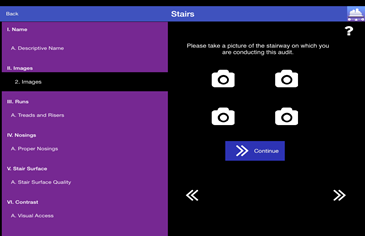
Watch “AccessTools”
Access Sound
Access Sound (Figs. 9-12) is an app that measures the decibel (dB) level in any room and provides the accessibility information for the recorded level. There are three sound levels to choose from: quiet activity, moderate activity, and loud activity (Fig. 9). Quiet activity represents a library type environment, moderate activity is the tone of a normal conversation, and loud activity is similar to the tone of a concert or mowing the grass. The measurement is taken on a steady surface to avoid interference. Results are presented in two different graphs. An x-y bar graph illustrates the dB levels recorded over the fifteen samples taken throughout the sample time. The second graph shows the median, maximum, and minimum dB levels taken during the measurement, in comparison to common environmental sounds, in order to indicate the noise level. It is possible to assign each measurement a location and description (Fig. 11). Access Sound can store up to 50 measurements and at any point these can be exported into a spread sheet, through email (Fig. 12).
Watch “AccessSound”-
Access Light
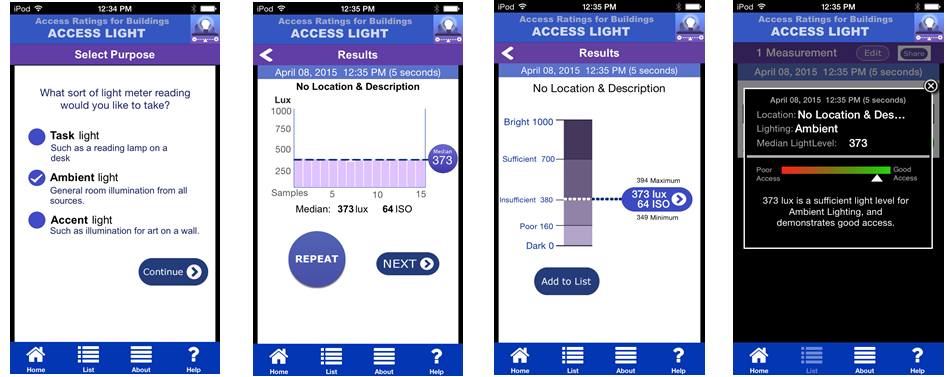
Access Light (Figs. 5-8) is an app that measures the light of any environment and indicates the accessibility of the brightness level. There are three light options to choose from: task light, ambient light, and accent light (Fig. 5). For example: task light could be a desk lamp, ambient light could be a general well-lit room, and accent light could be a spotlight. Once a type of lighting is selected, a Post-it® note is used to cover the front facing camera of the device to allow for the most accurate results to be recorded. The sticky one-third of a Post-it® can be torn off and used to cover the camera. Simply place the device face up on a steady surface while the measurement is being recorded. Results are presented in two different graphs. The first graph is an x-y bar graph that shows the lux values recorded over the fifteen samples taken during the measurement (Fig. 6). The next results page shows the median lux as compared to lux standards of brightness (Fig. 7). A location and description can be added to each measurement. Access Light can hold up to 50 measurements and at any time these can be exported to a spread sheet, through email.
Access Ruler
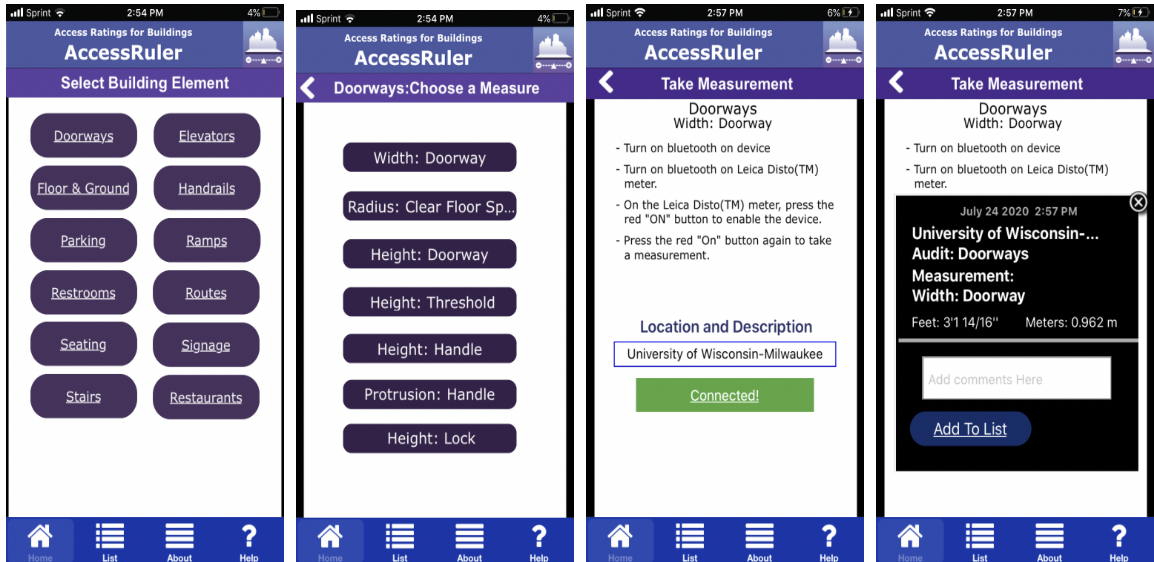
AccessRuler measures distances for accessibility purposes. This tool requires the use of a Leica Disto Meter that can connect to an iPad via Bluetooth. A measurement taken on the Leica Disto Meter will automatically show up in the app if it is opened and paired to the Leica Disto Meter. These distances are important to measure not only because of the accessibility requirements of buildings, but because of the limitations that may exist for individuals with disabilities. For example, a person in a wheelchair can only go through doors that are of a width wider than their wheelchair.
Watch “Access Ruler”-
Access Slope
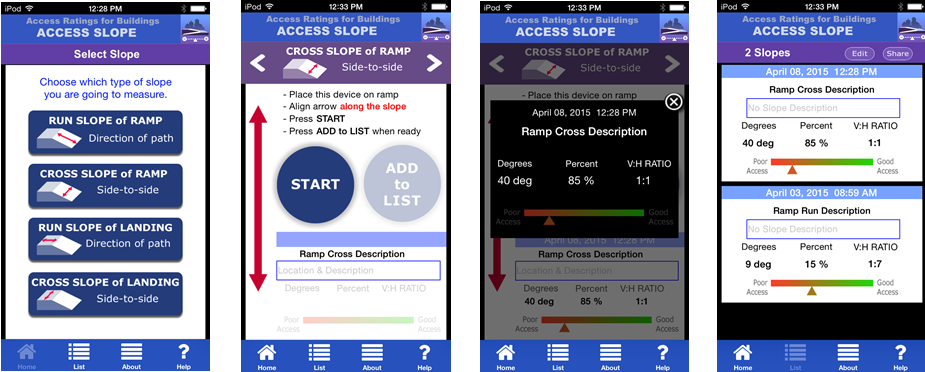
Access Slope (Figs. 1-4) is an app that allows users to measure the degrees, percent increase, and vertical:horizontal ratio of any ramp. There are four measurement options comprised of the run slope and cross slope of both the ramp and landing. (Fig. 1) The run slope follows the path of the ramp and the cross slope measures the slope along the width of the ramp. The device must be physically placed flat on the ramp for the measurements to be taken. Access Slope only requires three seconds to record each measurement. The results are ranked on a good access/poor access scale, taken from Americans with Disabilities Act (1990) requirements, which indicates the level of accessibility of the ramp. Users may add a location and description to each measurement. The app can store up to 50 measurements and at any point can be exported to a spread sheet, through email (Fig. 4).
Watch “Access Slope”-
Current Research Team
- University of Wisconsin – Milwaukee
- Roger O. Smith, PhD, OT, FAOTA, RESNA Fellow
- Nathan Spaeth, BS
- Mason Drake, OTD, OT
- Hanna Noyce, BS
- Elizabeth Cassell
- Kaitlin Schultz
- Rachel Page
- Marquette University
- Sheikh Iqbal Ahamed, PhD
- Nafi Sabith
- Samaun
- Columbia University
- Rochelle Mendonca, PhD, OTR
- University of New Mexico – Medical Center
- Suzanne Burns, PhD, OTR
- UW Green Bay
- Sayeda Farzana Aktar, Ph.D., CSE
- Independence First
- Cindi Pichler
- Nina Gutmanis, OTR
- Occupational Therapy and Accessibility Consultant
- Steven Sizer, MS, OTR/L
- Ellison Brooks, MS, OTR/L
Project Bibliography
App Availability
Rehabilitation Research Design & Disability Center. (2021). AccessSlope, Apple AppStore Version 6.1 [Mobile Application Software]. University of Wisconsin-Milwaukee. https://apps.apple.com/us/app/accessslope/id972504534
Rehabilitation Research Design & Disability Center. (2021). AccessSound, Apple AppStore Version 3.0 [Mobile Application Software]. University of Wisconsin-Milwaukee. https://apps.apple.com/us/app/accesssound/id1127105979
Rehabilitation Research Design & Disability Center. (2021). AccessRuler, Apple App Store Version 1.0 [Mobile Application Software]. University of Wisconsin-Milwaukee. https://apps.apple.com/us/app/accessruler/id1538489072
Rehabilitation Research Design & Disability Center. (2022-current) AccessTools (Research Version 4.0 Build 85). [Mobile Application Software]. University of Wisconsin-Milwaukee.
Rehabilitation Research Design & Disability Center. (2022-current) AccessPlace Mobile (Research Version). [Mobile and Web Application Software]. University of Wisconsin-Milwaukee.
Publications and Proceedings
2021
Obiedat, Q. M., Schwartz, J., Mendonca, R., Burns, S., Drake, M. D., O’Donnell, L. M., Smith, R. O. (2021). Using Video Recordings As a COVID-19 Adaptation To Study The Inter-Rater Reliability of The AccessTools App. Proceedings of the RESNA 2021 Virtual International Conference. Retrieved from: https://www.resna.org/sites/default/files/conference/2021/ServiceDeliveryandOutcomes/112_Obiedat.html
O’Donnell, L. M., Drake, M. D., Smith, R. O. (2021). AccessPlace Stakeholder Product Validation. Proceedings of the RESNA 2021 Virtual International Conference. Retrieved from: https://www.resna.org/sites/default/files/conference/2021/NewEmergingTechnology/111_ODonnell.html
Smith, R. O., Schwartz, J. K., Burns, S., Mendonca, R., Pickens, N., Drake, M. D., O’Donnell, L. M., Obiedat, Q. (2021).The Impact of Community Accessibility Assessment: A National Multisite Study. Proceedings of the 2021 Virtual OT Summit of Scholars. Retrieved from: https://uwm.edu/r2d2/wp-content/uploads/sites/438/2021/07/2021_OT_Summit_proceedings_23-to-25-June.pdf
Schwartz, J. K., Burns, S., Mendonca, R., Obiedat, Q., Smith, R. O. (2021). Feasibility of a Self-Paced Training on Standardized Assessment of the Community Environment. Proceedings of the 2021 Virtual OT Summit of Scholars. Retrieved from: https://uwm.edu/r2d2/wp-content/uploads/sites/438/2021/07/2021_OT_Summit_proceedings_23-to-25-June.pdf
2020
Park, M., Park, K.-H., Park, J.-H., & Smith, R. O. (2020). The Restaurant Accessibility and Task Evaluation Tool: Development and Preliminary Validation. Therapeutic Science for Rehabilitation, 9(3), 35–51. https://doi.org/10.22683/TSNR.2020.9.3.035.
Smith, R. O., Drake, M. A. D., O’Donnell, L., Bauman, K., Sullivan, M., Pearson, S., Ives, C. & McGavock, K. (2020). Access ratings for buildings: Utilization of community engagement events to populate the database with accessible information. RESNA, Virtual Conference.
Smith, R. O., Drake, M. A. D., Sullivan, M., Pearson, S., Ives, C. & McGavock, K. (2020). Access Ratings for Buildings: Piloting Community Engagement Events for Populating the Database with Accessibility Information for AccessPlace. OT Summit, Virtual Conference.
2019
McCartney, A., Smith, R. O. (June, 2019). Evaluating the need for validation of AccessTools for deaf individuals: A qualitative study. Poster Presentation at the 2019 RESNA/RehabWeek conference, Toronto, Canada. RESNA 2019 conference abstracts, Assistive Technology, 31:5, 231-250, DOI: 10.1080/10400435.2019.1682374
Smith, R.O., Tomashek, D., Wilson, C. (June, 2019). Perspectives on Building Accessibility: Survey responses by people with disabilities on accessibility experiences and the need for information. Platform presentation at the 2019 RESNA/RehabWeek conference, Toronto, Canada. RESNA 2019 conference abstracts, Assistive Technology, 31:5, 231-250, DOI: 10.1080/10400435.2019.1682374
Wu, J., Hu, W., Coelho, J., Nitu, P., Paul, H.R., Madiraju, P., Smith, R.O., Ahamed, S.I. (July, 2019). Identifying Buildings with Ramp Entrances Using Convolutional Neural Networks. Paper. 2019 IEEE 43rd Annual Computer Software and Applications Conference (COMPSAC). Milwaukee, WI. Retrieved from https://epublications.marquette.edu/cgi/viewcontent.cgi?article=1017&context=comp_fac
2018
Tomashek, D., Spaeth, N., Latzig, N., Pelkey, A., Smith, R.O. (2018) Validation of the AccessPlace Personal Accessibility Information Review Sorting. Platform given at the Rehabilitation Engineering Assistive Technology Society of North America Conference (RESNA), Arlington, VA. Retrieved from https://www.resna.org/sites/default/files/conference/2018/jea/Tomashek.html
2017
Tomashek, D., Smith, R.O, Spaeth, N., Schuh, C. (2017, July). Access Ratings For Buildings: Use As A Learning Tool For Building Assessment Instruction. Poster Presentation. 40th Annual Rehabilitation Engineering and Assistive Technology Society of North America Conference, New Orleans, LA. Retrieved from https://www.resna.org/sites/default/files/conference/2017/pdf_versions/public_policy/Thomasheck.pdf
2016
Williams, D., Johnson, N., Saha, A.K., Spaeth, N., Tomashek, D., Ahamed, S.I., Smith, R.O. (2016, July) Access Ruler: An Accessible Measurement Application for Determining Accessibility In The Built Environment. Paper. 39th Annual Rehabilitation Engineering and Assistive Technology Society of North America Conference, Washington, D.C. Retrieved from http://www.resna.org/sites/default/files/conference/2016/Cac/williams.html
2015
Johnson, N, Saxena,P, Williams, D, Bangole, O.C., Hasan, K, Ahamed, S.I., Smith, R.O., & Tomashek, D. (2015). Smartphone-based light and sound intensity calculation application for accessibility measurement. Poster session at the RESNA 38th International Conference on Technology and Disability: Research, Design, Practice and Policy. Denver, CO. Retrieved from http://www.resna.org/sites/default/files/conference/2015/cac/johnson.html
Spaeth, N.L., Tomashek, D., & Smith, R.O. (2015). AccessPlace: Personalized accessibility information for buildings. Platform session at the RESNA 38th International Conference on Technology and Disability: Research, Design, Practice and Policy. Denver, CO. Retrieved from http://www.resna.org/sites/default/files/conference/2015/cac/spaeth.html
Tomashek, D., Baumann, R., & Smith, R.O. (2015). Dining experiences and the impact of accessibility information for people with disabilities: A pilot study. Platform session at the RESNA 38th International Conference on Technology and Disability: Research, Design, Practice and Policy. Denver, CO. Retrieved from https://www.resna.org/sites/default/files/conference/2015/cac/tomashek.html
White, K. & Smith, R.O. (2015). Determining accessibility for iOS applications: A checklist for practitioners. Platform session at the RESNA 38th International Conference on Technology and Disability: Research, Design, Practice and Policy. Denver, CO. Retrieved from http://www.resna.org/sites/default/files/conference/2015/cac/white.html
Williams, D, Johnson, N, Bangole, O.C., Hasan, K, Tomashek, D, Ahamed, S.I. & Smith, R.O. (2015). Access Tools: Developing a Usable Smartphone-Based Tool for Determining Building Accessibility. Platform session at the RESNA 38th International Conference on Technology and Disability: Research, Design, Practice and Policy. Denver, CO. Retrieved from http://www.resna.org/sites/default/files/conference/2015/cac/williams.html
2014
Baumann, R., Schwartz, J., & Smith, R. O. (2014, June). Creating accessible mobile applications: A case study of lessons and challenges. Proceedings of the RESNA 37th International Conference on Technology and Disability: Research, Design, Practice and Policy, Indianapolis, IN. Retrieved from http://www.resna.org/sites/default/files/conference/2014/CAC/Baumann.html
Tomashek, D., Smith, R. O., Schwartz, J., & Ahamed, S. I. (2014, June). Development, concurrent validity, and instrument reliability of the Access Slope Mini-Tool mobile app. Proceedings of the RESNA 37th International Conference on Technology and Disability: Research, Design, Practice and Policy, Indianapolis, IN. Retrieved from http://www.resna.org/sites/default/files/conference/2014/JEA/Tomashek.html
Negar, N., Williams, D., Schwartz, J., Ahamed, S. I., & Smith, R. O. (2014). Smartphone-based light intensity calculation application for accessibility measurement. Proceedings of the RESNA 37th International Conference on Technology and Disability: Research, Design, Practice, & Policy, Indianapolis, IN. Retrieved from http://www.resna.org/sites/default/files/conference/2014/CAC/Negar.html
Smith, R. O., Schwartz, J., & Ahamed, S. I. (2014). Access rating for buildings: A smartphone based system promoting community accessibility. Proceedings of the RESNA 37th International Conference on Technology and Disability: Research, Design, Practice, & Policy, Indianapolis, IN. Retrieved from http://www.resna.org/sites/default/files/conference/2014/JEA/Smith.html
2013
Anson, D. Schwartz, J. K. Smith, R.O. (2013). Environmental accessibility assessment: Alternative approaches for alternate users. Proceedings of the RESNA 36th International Conference on Technology and Disability: Research, Design, Practice, & Policy, Bellevue, WA. Retrieved from http://www.resna.org/sites/default/files/legacy/conference/proceedings/2013/JEA/Anson.html
Gani, O., O’Brien, C., Ahamed, S., & Smith, R. O. (2013). RSSI based indoor localization for smartphone using fixed and mobile wireless node. IEEE 37th Annual Computer Software and Applications Conference (COMPSAC), 110-117. doi: 10.1109/COMPSAC.2013.18
Jahangir, A. K. M., Majumder, A., Zerin, I., Uddin, M., Ahamed, S., & Smith, R. O. (2013). SmartPrediction: A real-time smartphone-based fall risk prediction and prevention system. ACM-Research in Adaptive and Convergent Systems, 434-439. https://dl.acm.org/doi/10.1145/2513228.2513267
Edyburn, K. D., Schwartz, J. K., Smith, R. O. (2013). A case study: Development of access ratings for buildings “consumer” mobile app. Proceedings of the RESNA 36th International Conference on Technology and Disability: Research, Design, Practice, & Policy. Bellevue, WA. Retrieved from http://www.resna.org/sites/default/files/legacy/conference/proceedings/2013/CAC/Edyburn.html
Jahangir, A. K. M., Majumder, A., Ahamed, S. I., & Smith, R. O. (2013). iDistanceM: A real-time smartphone-based distance measurement for the Americans with Disabilities Act Compliance Assessment Tool. Proceedings of the RESNA 36th Annual Conference on Technology and Disability: Research, Design, Practice, & Policy, Bellevue, WA. Retrieved from http://www.resna.org/sites/default/files/legacy/conference/proceedings/2013/JEA/Majumder.html
Rahman, F., O’Brien, C., Ostberg, C., Negar, N., Duc, D., Ahamed, S. I., et al. (2013). Measuring font signage with a smartphone application for ADAAG compliance assessment. Proceedings of the RESNA 36th Annual Conference on Technology and Disability: Research, Design, Practice, & Policy, Bellevue, WA. Retrieved from http://www.resna.org/sites/default/files/legacy/conference/proceedings/2013/Outcomes/Ahamed2.html
Schwartz, J. K. O’Brien, C. Edyburn, K. Ahamed, S.I. Smith, R.O. (2013). Smartphone based solutions to measure the built environment and enable participation. Proceedings of the RESNA 36th Annual Conference on Technology and Disability: Research, Design, Practice, & Policy, Bellevue, WA. Retrieved from http://www.resna.org/sites/default/files/legacy/conference/proceedings/2013/CAC/Schwartz.html
2011
Park, M. & Smith, R.O. (2011). Preliminary Validation of the Restaurant Accessibility and Task Evaluation Information Tool (RATE-IT): Content and Construct Validity. Paper presented at American Occupational Therapy Association, Philadelphia, Pennsylvania (PA).
Park, M., Smith, R.O. & Liegl, K. (2011). Preliminary Validation of the Restaurant Accessibility and Task Evaluation Information Tool (RATE-IT): Content and Construct Validity, Presented at Rehabilitation Engineering and Assistive Technology Society of America (RESNA), Toronto, Canada.
Liegl, K.P., Lemke, M.R., Park, M., Erfurth, A., & Smith, R.O. (2011). Differences between Architecture and Occupational Therapy Student Perceptions of Restaurant Accessibility using the RATE-IT Evaluation Tool. Presented at the National Conference on Undergraduate Research, Ithaca, New York (NY).
Liegl, K.P., & Lemke, M.R. (2011). Student Perceptions of the RATE-IT evaluation tool and usefulness of RATE-IT scores for people with disabilities. Presented at the 11th Annual University of Wisconsin System Symposium for Undergraduate Research and Creative Activity, Parkside, Wisconsin (WI).
Park, M (2011). Preliminary Validation of the Restaurant Accessibility and Task Evaluation Information Tool (RATE-IT): Content and Construct Validity. UWM Library: University of Wisconsin – Milwaukee.
Erfurth, A (2011). Measurement of restaurant accessibility by people with disabilities: Preliminary consequential and construct validity of a restaurant universal design assessment. UWM Library: University of Wisconsin – Milwaukee.
Presentations
McCartney, A., Smith, R. O. (June, 2019). Evaluating the need for validation of AccessTools for deaf individuals: A qualitative study. Poster Presentation at the 2019 RESNA/RehabWeek conference, Toronto, Canada. Retrieved from: https://www.resna.org/sites/default/files/conference/2019/other/McCartney.html and (2019) RESNA 2019 conference abstracts, Assistive Technology, 31:5, 231-250, DOI: 10.1080/10400435.2019.1682374
Tomashek, D., Spaeth, N., Latzig, N., Pelkey, A., Smith, R.O. (2018) Validation of the AccessPlace Personal Accessibility Information Review Sorting. Platform given at the Rehabilitation Engineering Assistive Technology Society of North America Conference (RESNA), Arlington, VA. Retrieved from https://www.resna.org/sites/default/files/conference/2018/jea/Tomashek.html
Tomashek, D. Smith, R.O., Spaeth, N. (2017, June) Access Ratings for Buildings: Use as a Learning Tool for Building Assessment Instruction. Platform and Poster Presentations at the 40th Annual Rehabilitation Engineering and Assistive Technology Society of North America Conference, New Orleans, LA.
Tomashek, D., Smith, R.O. (2017, January) AccessTools: A Multitool App for Assessing the Built Environment. Session at the Spring 2017 Assistive Technology Industry Association Conference, Orlando, FL.
Domke, H., Smith, R.O., Tomashek, D. (2017, April). Appy Hour: Home and Public Building Accessibility Evaluation Apps. Tech Day Presentation at the 97th Annual American Occupational Therapy Association Conference, Philadelphia, PA.
Smith, R.O., Domke, H., Tomashek, D. (2017, April). The AccessTool App: Measuring Accessibility of the Built Environment. Tech Day Presentation at the 97th Annual American Occupational Association Conference, Philadelphia, PA.
Smith, R.O. (2017, April). Keynote: Measuring Community Building Accessibility: The AccessTools Apps. Invited presentation at 2017 International Conference on Biomechanics, Rehabilitation Engineering and Assistive Technology, National Penghu University of Science and Technology, Magong City, Penghu County, Taiwan.
Smith, R.O. (2016, November). Keynote: Using the Cloud for People with Disabilities: the Example of Access Ratings for Buildings. Invited Plenary Presentation at the RESKO (Rehabilitation Engineering and Assisted Technology Society of Korea), Seoul, South Korea.
Williams, D., Johnson, N., Saha, A.K., Spaeth, N., Tomashek, D., Ahamed, S.I., Smith, R.O. (2016, July) Access Ruler: An Accessible Measurement Application for Determining Accessibility In The Built Environment. Paper. 39th Annual Rehabilitation Engineering and Assistive Technology Society of North America Conference, Washington, D.C. https://www.resna.org/sites/default/files/conference/2016/Cac/williams.html
Smith, R.O., Tomashek, D., & Domke, H. (2016, April). AccessPlace: Personalized Accessibility Information for Buildings. Tech Day session at the 96th Annual American Occupational Therapy Association Conference, Chicago, IL.
Smith, R.O., Pickens, N., Burns, S., Mendonca, R., Tomashek, D., & Domke, H. (2016, April). Home and Public Building Accessibility Evaluation Apps. Tech Day session at the 96th Annual American Occupational Therapy Association Conference, Chicago, IL.
Smith, R.O., Tomashek, D., & Domke, H. (2016, April). AccessRuler: Instant Documentation and Upload of Distance Measurements into the AccessTools App Suite. Tech Day session at the 96th Annual American Occupational Therapy Association Conference, Chicago, IL.
Proffitt, R., Morris, J., Wallace, T., Schwartz, J., Smith, R. O., & Finestone, H. (2015). Developing, testing, and implementing technologies and video games into clinical practice. Presentation at the ACRM 92nd Annual Conference, Progress in Rehabilitation Research (PIRR), Dallas, TX. https://acrm.org/conference/developing-testing-and-implementing-technologies-and-video-games-into-clinical-practice-2830/
Schwartz, J. K., Proffitt, R., Foreman, M, and Smith, R. O. (2015). The role of an occupational therapist in the development of apps, games, and other software: An emerging practice area. Poster at the 95th Annual American Occupational Therapy Association Conference, Nashville, TN.
Smith, R.O. & Schwartz, J. K. (2015). Access ratings for buildings: A novel smartphone based evaluation & intervention for community accessibility. Poster at the American Occupational Therapy 95th Annual Conference and Exposition, Nashville, TN.
Tomashek, D. & Smith, R.O. (2015). AccessTools for measuring the accessibility of buildings. Tech Day session at the 95th Annual American Occupational Therapy Association Conference, Nashville, TN.
Smith, R.O. & Tomashek, D. (2015). Apps for rating the accessibility of buildings. Presentation at the 15th Annual Assistive Technology Industry Association Conference, Orlando, FL.
Tomashek, D. & Smith, R.O. (2015). Development of assessment apps: Unique development & testing requirements. Presentation at the 15th Annual Assistive Technology Industry Association Conference, Orlando, FL.
Baumann, R., Schwartz, J., & Smith, R. O. (2014). Creating accessible mobile applications: A case study of lessons and challenges. Paper presented at the RESNA 37th International Conference on Technology and Disability: Research, Design, Practice & Policy, Indianapolis, IN. https://www.resna.org/sites/default/files/conference/2014/CAC/Baumann.html
Smith, R. O., Schwartz, J., & Anson, D. (2014). Smart tools for evaluating the built environment. Presentation at the 94th Annual American Occupational Therapy Association Conference and Expo, Baltimore, MD.
Smith, R. O., & Schwartz, J. (2014). Access rating for buildings: A smartphone based system for accessibility. Presentation at the 94th Annual American Occupational Therapy Association Conference, Baltimore, MD.
Smith, R. O., & Schwartz, J. K. (2014). So you want to make an app?: A case study of app development for OT evaluation and intervention. Presentation at the 94th Annual American Occupational Therapy Association Conference and Expo, Baltimore, MD.
Smith, R. O., & Schwartz, J. (2014). The development of access rating for buildings: Apps for community access. Paper presented at the 3rd Annual Occupational Science Summit, Philadelphia, PA.
Schwartz, J., & Smith, R. O. (2014). Development of an app based evaluation of the community environment. Paper at the 94th Annual American Occupational Therapy Association Conference, Baltimore, MD.
Tomashek, D., Smith, R. O., Schwartz, J., & Ahamed, S. I. (2014). Development, concurrent validity, and instrument reliability of the access slope mini-tool mobile app. Paper at the RESNA 37th International Conference on Technology and Disability: Research, Design, Practice, & Policy, Indianapolis, IN. https://www.resna.org/sites/default/files/conference/2014/JEA/Tomashek.html
Edyburn, K., Schwartz, J., Smith, R.O., (2013). A case study: Development of Access Ratings for Buildings “Consumer” mobile app. Proceedings of the RESNA 36th International Conference on Technology and Disability: Research, Design, Practice, & Policy, Indianapolis, IN. https://www.resna.org/sites/default/files/legacy/conference/proceedings/2013/CAC/Edyburn.html
Mendonca, R., Smith, R. O., Pickens, N., Struckmeyer, L., Anson, D., & Schwartz, J. K. (2013). Evaluating accessibility in the world around you: Assessment tools and approaches for public spaces, home residences, products, information, and educational materials. Paper presented at the 93rd Annual American Occupational Therapy Association Conference and Expo, San Diego, CA.
Schwartz, J. K., & Smith, R. O. (2013). Access Ratings for Buildings: Measuring building accessibility in the community environment. Paper presented at the Second Annual Occupational Therapy Summit of Scholars, Chicago, IL.
Park, M. & Smith, R.O. (2011). Preliminary Validation of the Restaurant Accessibility and Task Evaluation Information Tool (RATE-IT): Content and Construct Validity. Paper presented at American Occupational Therapy Association, Philadelphia, Pennsylvania (PA).
Park, M., Smith, R.O. & Liegl, K. (2011). Preliminary Validation of the Restaurant Accessibility and Task Evaluation Information Tool (RATE-IT): Content and Construct Validity. Presented at Rehabilitation Engineering and Assistive Technology Society of America (RESNA), Toronto, Canada.
Liegl, K.P., Lemke, M.R., Park, M., Erfurth, A., & Smith, R.O. (2011). Differences between Architecture and Occupational Therapy Student Perceptions of Restaurant Accessibility using the RATE-IT Evaluation Tool. Presented at the National Conference on Undergraduate Research, Ithaca, New York (NY).
Liegl, K.P., & Lemke, M.R. (2011). Student Perceptions of the RATE-IT evaluation tool and usefulness of RATE-IT scores for people with disabilities. Presented at the 11th Annual University of Wisconsin System Symposium for Undergraduate Research and Creative Activity, Parkside, Wisconsin (WI).